
FASTag for Commercial Vehicle
FASTag on an Indian goods vehicle: which toll class you fall in, why the Rs 3,000 annual pass excludes trucks, blacklisting, and the overload fee link.

Lokesh R
CEO of Trucks India
Created 24 September 2026 · 6 min read

Two things about FASTag catch truck owners out, and neither is the tag itself.
The first is that the widely publicised ₹3,000 annual pass is not available to you. It is for private cars, jeeps and vans, and commercial vehicles are explicitly excluded. Plenty of operators have gone looking for it.
The second is that since April 2026 your FASTag is how overload charges get collected. The tag is no longer just a toll payment method; it is the mechanism for a penalty that can run at four times the base rate.
The annual pass does not apply to you
Since this is the most common question, deal with it first.
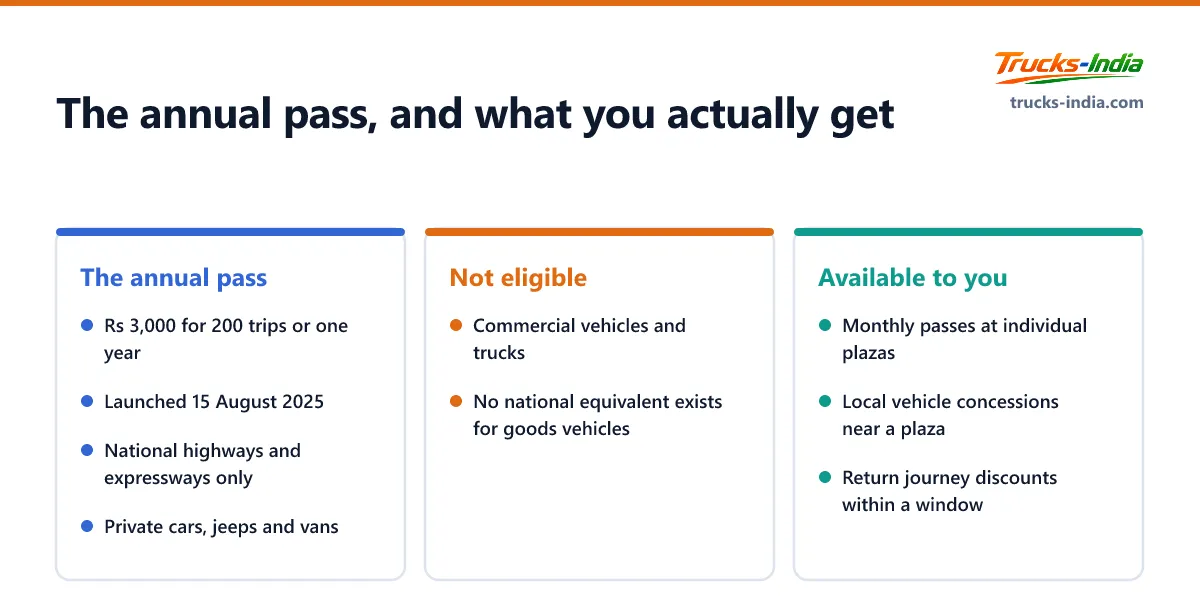
The FASTag Annual Pass, launched on 15 August 2025, costs ₹3,000 and covers 200 trips or one year, whichever comes first, on national highways and expressways. It is bought through the Rajmargyatra app or the NHAI website.
It is available to private, non commercial vehicles only: cars, jeeps and vans. Commercial vehicles and trucks are not eligible.
There is no equivalent national annual product for goods vehicles. What does exist is the monthly pass offered at individual plazas for vehicles working a fixed local route, which is a plaza level arrangement rather than a national scheme, and the local exemption discussed below.
Which class your vehicle falls in
Toll is charged by vehicle class, and for goods vehicles the class is driven by axle count, not by tonnage or by what the vehicle looks like.
The broad ladder runs from light commercial vehicles and mini buses, through two axle trucks and buses, three axle vehicles, heavy construction machinery and multi axle vehicles of four to six axles, and then seven axles and above. Each step up is a higher multiple of the car rate.
Two practical points.
Your class is fixed by the vehicle, so know it before you dispute a charge. Arguing at a plaza about being charged as a three axle vehicle when you are one is a losing evening.
The tag is issued against the vehicle. A tag bought for one class and stuck on a different vehicle will mismatch at the plaza and cause exactly the delay the system exists to avoid.
Getting and running the tag
FASTag is issued by banks and by authorised issuers, and by NHAI at points of sale near plazas. You need the registration certificate and owner KYC.
Three operating rules that matter more on a fleet than on a car.
Keep it funded. An insufficient balance at a plaza is the single most common failure, and the consequence is delay at best.
Avoid blacklisting. A tag can be blacklisted for a persistently low balance or a KYC problem, and a blacklisted tag does not work at any plaza. Clearing it takes time you do not have on a loaded run.
One tag per vehicle, correctly affixed. On the windscreen, in the specified position, not carried loose in the cab. A tag held up to the reader is a tag that reads intermittently.
For a fleet, the useful arrangement is a single wallet or corporate account funded centrally rather than each driver topping up individually. It removes the low balance failure and it gives you the transaction record, which is the next section.
The data is worth more than most owners realise
Every plaza crossing is logged with a time, a location and an amount.
That record does three jobs.
It is a toll cost per route, which you can put into your rate calculation properly rather than estimating, and the toll charges guide explains how the rate is built and which discounts you can claim. Toll is a real line in the cost sheet covered in the margin guide.
It is proof of where the vehicle was. A FASTag transaction is one of the cleanest ways to contest a wrongly issued challan, as the guide to checking a truck challan online sets out.
It is a check on trip reporting. Crossings that do not match the trips you were told about are worth a conversation.
FASTag now collects overload charges
This is the change most operators have not registered.
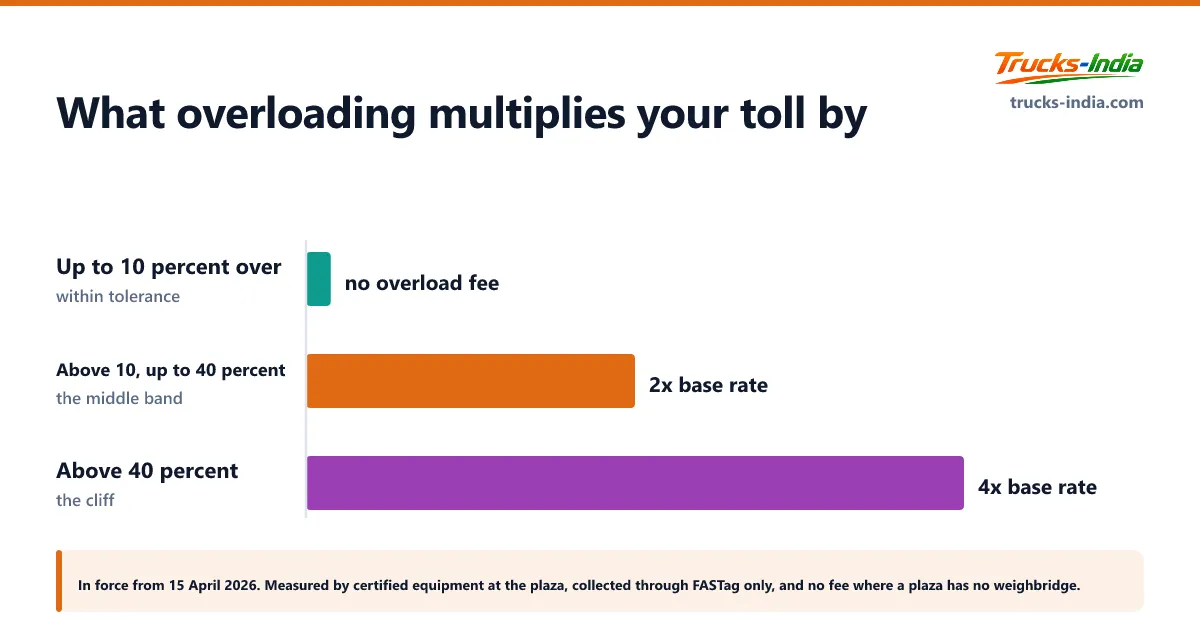
Under the National Highways Fee (Determination of Rates and Collection) Fourth Amendment Rules 2026, in force from 15 April 2026, overloaded vehicles are charged on a tiered basis at fee plazas: nothing up to 10 percent excess, two times the base rate above 10 and up to 40 percent, and four times the base rate above 40 percent.
Three details follow.
Overloading is determined by certified weighing equipment at the plaza. Where a plaza has no weighing facility, no overload fee is levied. And the fee is collected through FASTag only.
So the tag that pays your toll is now also the instrument that collects a multiplied penalty, and an underfunded tag at a plaza where you are overloaded is a compounding problem. The weight side of it is covered in the axle load and overloading rules.
Exemptions and refunds
Local vehicles registered within a defined distance of a plaza are generally eligible for concessional monthly arrangements. If you run a short fixed route past one plaza repeatedly, ask at that plaza rather than assuming it does not exist.
Return journey discounts apply at many plazas for a return within a defined window, which is worth knowing on out and back runs.
Deductions do go wrong. Double deductions and wrong class charges happen. Raise them with your issuing bank or through the NHAI grievance route with the transaction details, and do it promptly rather than at the end of the quarter, because a stale dispute is harder to resolve.
Frequently asked questions
No. The annual pass, launched on 15 August 2025 for ₹3,000 covering 200 trips or one year, is for private non commercial vehicles only, meaning cars, jeeps and vans. Commercial vehicles and trucks are explicitly excluded, and there is no national equivalent for goods vehicles.
By vehicle class, which for goods vehicles is driven by axle count rather than tonnage. The ladder runs from light commercial vehicles up through two axle, three axle, four to six axle and seven axle and above, each a higher multiple of the car rate.
You are delayed, and persistent low balance can get the tag blacklisted. A blacklisted tag does not work at any plaza and clearing it takes time. For a fleet, a centrally funded wallet avoids the problem entirely.
Yes, since 15 April 2026. Overload fees are tiered, at nothing up to 10 percent excess, two times the base rate above 10 and up to 40 percent, and four times above 40 percent, measured by certified equipment at the plaza and collected through FASTag only. Plazas without weighing facilities levy no overload fee.
At plaza level, yes. Monthly passes and concessional rates are offered at individual plazas, typically for vehicles registered locally or working a fixed route past that plaza. Ask at the plaza concerned, because it is a local arrangement rather than a national scheme.
Through your issuing bank or the NHAI grievance route, with the transaction details, and promptly. Double deductions and wrong class charges do happen, and a dispute raised weeks later is much harder to resolve than one raised the same week.
Where this fits
Toll is a per trip cost line. See our guide to toll charges for trucks per km.
Your toll class follows the vehicle's axle count. Trucks India lists configuration and price for every model in India.
Call +91 93422 00875About the author
Lokesh R
CEO of Trucks India
Lokesh R is the founder of Trucks India, an independent heavy-vehicle marketplace and research platform operated from Chennai, Tamil Nadu, founded in 2025. Under his direction, Only Heavy publishes specifications and prices sourced from manufacturers, authorised dealer price lists and official regulatory schedules, with every model page checked by a named reviewer, prices re-verified monthly and after any GST revision, and no advertiser able to buy a rating, ranking or comparison result.


