
How to Check Truck Challan Online
How to check and pay a commercial vehicle challan online in India using the Parivahan e-challan portal, what blocks a renewal, and how to contest a wrong one.

Lokesh R
CEO of Trucks India
Created 4 September 2026 · 6 min read
Most truck challans now arrive without anybody stopping the vehicle. A camera reads the plate, the system matches it against the vehicle record, and the notice sits in a database waiting for somebody to look.
That is why unpaid challans surface at the worst moments: at a fitness renewal, at a permit renewal, at a transfer of ownership, or at a check post where an officer pulls the record while your load waits. Checking takes two minutes and there is no reason not to do it monthly.
Where to check
The national source is the e-challan service on the Parivahan portal, run by the Ministry of Road Transport and Highways. It carries challans issued across states, which matters for a truck that crosses borders, because a notice raised in one state will not appear on that state's police site once you are home.
Several state transport and traffic police portals also show challans, and some show them sooner. They are useful as a second look, but the national portal is the one that gives you the whole picture for an interstate vehicle.
The mParivahan app shows the same information on a phone, which is the practical option for a driver or an owner away from a desk.
How to check
The process takes a couple of minutes.
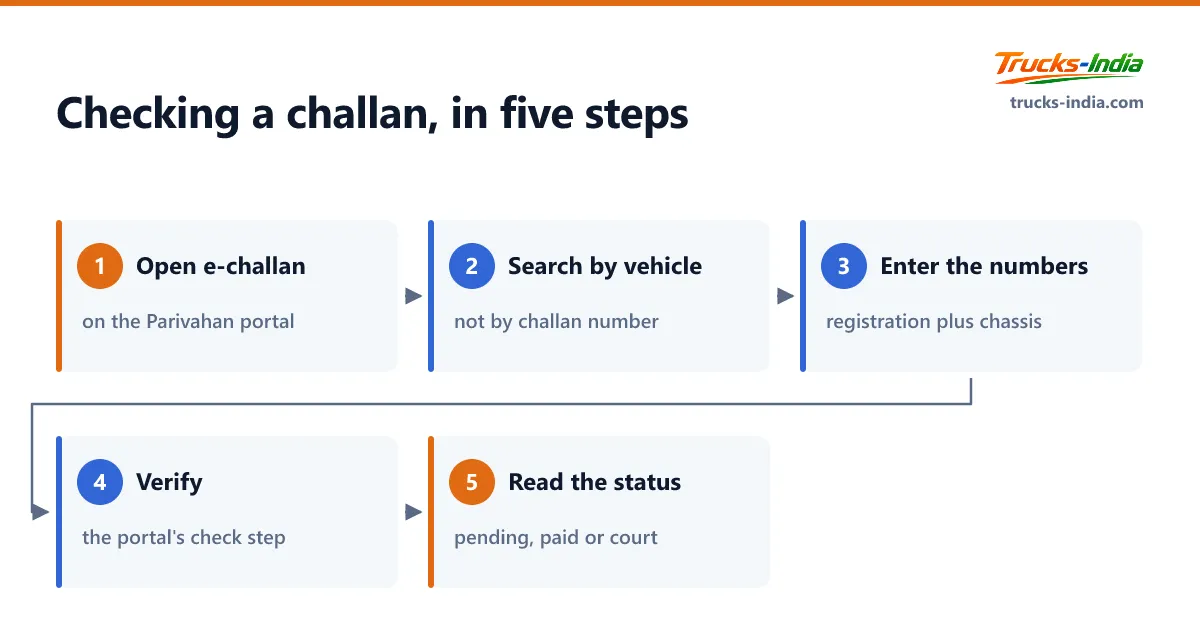
- Open the e-challan section of the Parivahan portal.
- Choose to search by vehicle number, which is the useful option for an owner. You can also search by challan number if you have a notice, or by driving licence number to see challans against a driver.
- Enter the registration number and the chassis or engine number where asked. The portal asks for a second identifier so that anybody cannot pull up any vehicle.
- Complete the verification step.
- The result lists each challan with its date, the offence, the amount and whether it is pending, paid or sent to court.
Keep the chassis and engine numbers written down somewhere reachable. They are on the registration certificate, and needing them is the most common reason this check gets postponed.
Reading the result
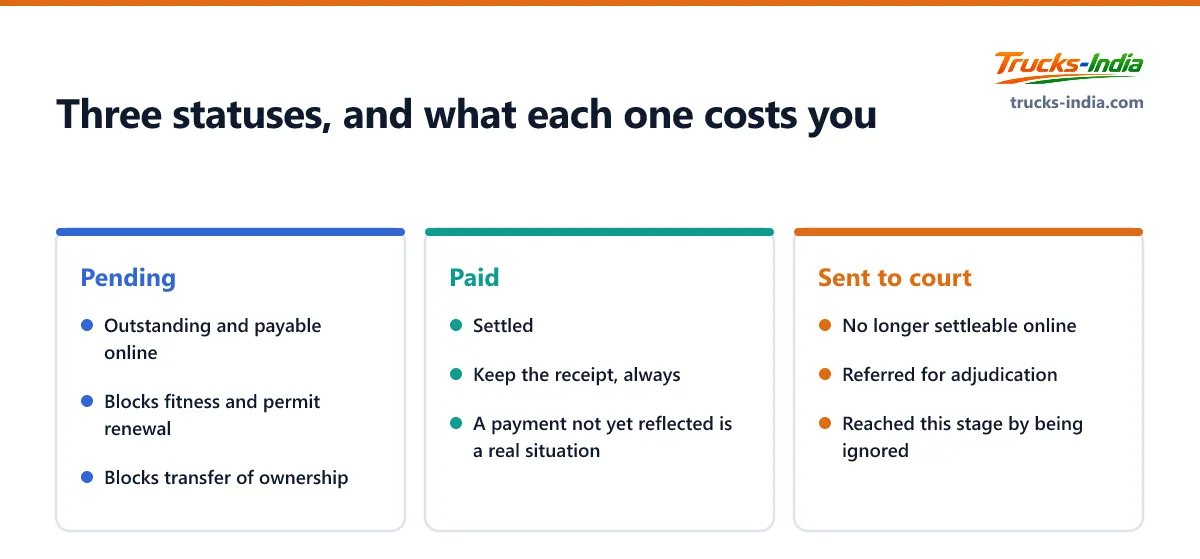
Three statuses matter.
Pending means it is outstanding and payable online.
Paid means settled. Keep the receipt, because a payment that has not reflected is a real situation and the receipt is your evidence.
Sent to court means the challan is no longer settleable online. It has been referred for adjudication and has to be dealt with through the court process, which is slower and needs attention rather than a card payment. Notices reach this stage by being ignored, which is the argument for checking regularly.
Paying
Pending challans can be paid directly on the portal by the usual online methods. The vehicle record updates, generally quickly, though not always instantly.
Download or screenshot the receipt every time. The single most common dispute is a challan showing as unpaid after money has left the account, and the receipt resolves it in a minute rather than a week.
Why this matters more for a truck than a car
Four reasons, and the first is the one that costs real money.
Renewals stall. Outstanding challans commonly block fitness renewal, permit renewal and transfer of ownership. A vehicle you planned to put back on the road on Monday does not go, because of a notice from four months ago that nobody saw. The fitness guide covers the renewal this most often blocks.
Your driver's offences are your vehicle's record. A challan raised against the vehicle stays with the vehicle regardless of who was driving. If you employ drivers, checking the vehicle record is the only way you find out what is happening on the road.
Interstate work spreads the exposure. A truck working four states can collect notices in four jurisdictions, and you will not be in any of them when the notice is raised.
It is a selling problem. A buyer's first check on a used vehicle is the record. Pending challans reduce what you get and slow the sale.
If a challan looks wrong
It happens, most often through a misread number plate.
Grounds worth contesting include a vehicle that was demonstrably elsewhere, a plate misread by a camera, a duplicate for one incident, or a challan against a vehicle you had already sold with the transfer completed.
The route is the grievance or dispute facility on the portal, or the issuing authority in the state concerned. Evidence is what decides it: a toll receipt, a fuel bill, a GPS record or a delivery document placing the vehicle somewhere else at that time. If you run tracking, this is one of the places it repays itself.
Do not simply ignore a challan you believe is wrong. Ignored notices move toward court, at which point being right becomes much more time consuming.
Make it a routine
Check monthly, per vehicle. It takes two minutes and it removes an entire category of surprise.
Check before any renewal, so a pending notice does not stall a fitness or permit application on the day.
Check before you buy a used truck, along with the RC status, which the RC check guide covers. Somebody else's unpaid challans become your problem once the vehicle is in your name, and they commonly hold up the transfer itself.
Keep receipts in one folder per vehicle, digital is fine.
Trucks to compare
A few popular trucks on Trucks India, with ex-showroom price and rated payload. Open one for its full price, specifications and mileage.
Browse more: Mini trucks, Light commercial vehicles, Heavy trucks, Euler EV trucks, Mahindra trucks, Maruti Suzuki trucks, Tata Motors trucks
Frequently asked questions
Use the e-challan service on the Parivahan portal, search by vehicle number, and enter the registration number together with the chassis or engine number as the second identifier. The result lists each challan with its date, offence, amount and status.
Yes, pending challans are payable directly on the portal. Always save the receipt, because a payment that has not yet reflected on the record is a common situation and the receipt is what resolves it.
It has been referred for adjudication and can no longer be settled online. It has to be dealt with through the court process. Challans usually reach this stage by being left unpaid, which is the reason to check regularly.
Commonly yes. Outstanding challans frequently hold up fitness renewal, permit renewal and transfer of ownership, so an old unnoticed challan can stop a vehicle going back on the road on the day you planned.
A challan raised against the vehicle stays with the vehicle and therefore with the owner's record, regardless of who was driving. If you employ drivers, checking the vehicle record is the only reliable way to know what is happening on the road.
Through the grievance or dispute facility on the portal, or with the issuing authority in the state that raised it. Evidence placing the vehicle elsewhere, such as a toll receipt, fuel bill, GPS record or delivery document, is what decides it. Do not ignore it, because ignored notices move toward court.
Where this fits
An unpaid challan blocks renewals. See our guide to documents to carry in a truck.
Clean records make a vehicle easier to sell and cheaper to run. Trucks India lists price, payload and mileage for every model in India.
Call +91 93422 00875About the author
Lokesh R
CEO of Trucks India
Lokesh R is the founder of Trucks India, an independent heavy-vehicle marketplace and research platform operated from Chennai, Tamil Nadu, founded in 2025. Under his direction, Only Heavy publishes specifications and prices sourced from manufacturers, authorised dealer price lists and official regulatory schedules, with every model page checked by a named reviewer, prices re-verified monthly and after any GST revision, and no advertiser able to buy a rating, ranking or comparison result.


