
Single Truck Business Profit: Can One Vehicle Work?
How a one truck operation actually makes money in India, why concentration risk changes every decision, and when a single vehicle beats a small fleet.

Lokesh R
CEO of Trucks India
Created 22 August 2026 · 6 min read
A one truck business is not a small version of a fleet. It behaves differently, and the differences matter more than the scale.
With one vehicle there is nothing to absorb a shock. A breakdown does not reduce your capacity by a fraction, it takes it to zero. A slow month has no other truck earning through it. Every fixed cost in the business sits on one set of wheels.
That sounds discouraging and it is not meant to be. Plenty of single truck operations work well, and some are more profitable per vehicle than fleets. But they work because of specific choices, not by accident.
What makes a single truck business profitable
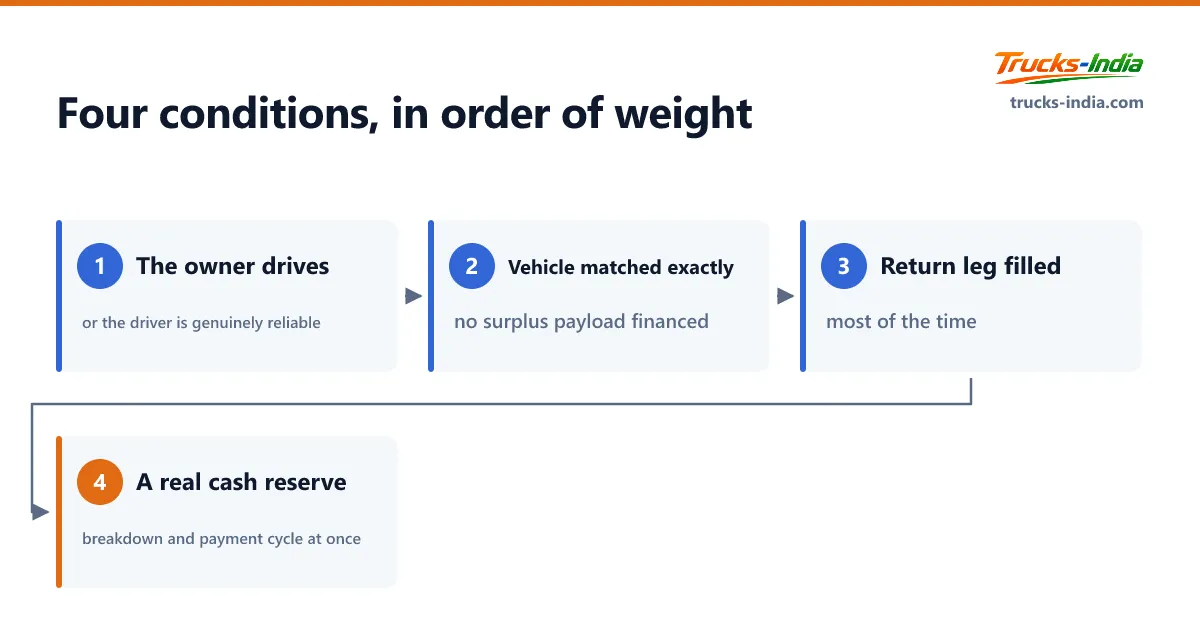
Four things, in roughly this order of importance.
- The owner drives, or the driver is genuinely reliable
- The vehicle is matched exactly to the loads available, with no surplus payload being financed
- The return leg is filled most of the time
- There is a cash reserve deep enough to survive a breakdown and the payment cycle at once
Miss the fourth and the other three do not save you.
Concentration risk is the defining feature
In a fleet of six, one truck in a workshop is a 17 percent capacity loss. In a fleet of one, it is everything. The EMI still arrives. The driver, if you employ one, still expects a wage. The client whose load you could not carry starts calling someone else.
This changes several decisions that would look over cautious at larger scale.
Maintenance stops being negotiable. Preventive servicing on schedule is cheap insurance against the only event that can stop your entire business.
The reserve needs to cover two problems at once. Not just the 30 to 60 day payment cycle, but a simultaneous major repair. Those two things have an unfortunate habit of arriving together.
Client concentration compounds it. One truck serving one client is two single points of failure stacked. If that client's volumes drop or their payments slow, there is no other work and no other vehicle.
The owner driver advantage is real
For a single truck, the driver's salary is one of the largest costs after the EMI. Removing it changes the arithmetic substantially, and it is the main reason owner driver operations can succeed on routes where an owner employing a driver would struggle.
Be honest about what that means though. Your income now includes payment for your own labour. The fair comparison is against what you would earn driving someone else's truck, plus the return on your capital, rather than treating the whole figure as business profit.
It also caps you. You cannot drive and simultaneously spend your days building client relationships, chasing payments and finding return loads on the truck load booking apps, and those activities are what grow the business. Some owner drivers settle it by taking attachment with a company, which buys utilisation at the cost of rate. Many single truck owners stay single truck owners for exactly this reason, and for some that is the right outcome.
Match the vehicle exactly
With one truck there is no averaging across a fleet. Every rupee of surplus payload you financed is a permanent cost against revenue you never earn, and every tonne of shortfall is work you turn away.
This is the argument for choosing the vehicle after you know your loads rather than before. Talk to two or three potential clients first. If the reliable work is 3 tonne city loads, the answer is in the under 10 lakh band with something like a Tata Ace Gold or Mahindra Jeeto. If it is regional freight, the 10 to 20 lakh band and a Tata Ultra T16 or Eicher Pro 2059 XP Plus class vehicle.
Mileage deserves particular weight here, because with a single truck there is no fleet average to hide a thirsty vehicle in. Check the real mileage figure against today's fuel prices before committing.
Where a single truck beats a fleet
It is worth saying that one truck is not simply a stage on the way to more.
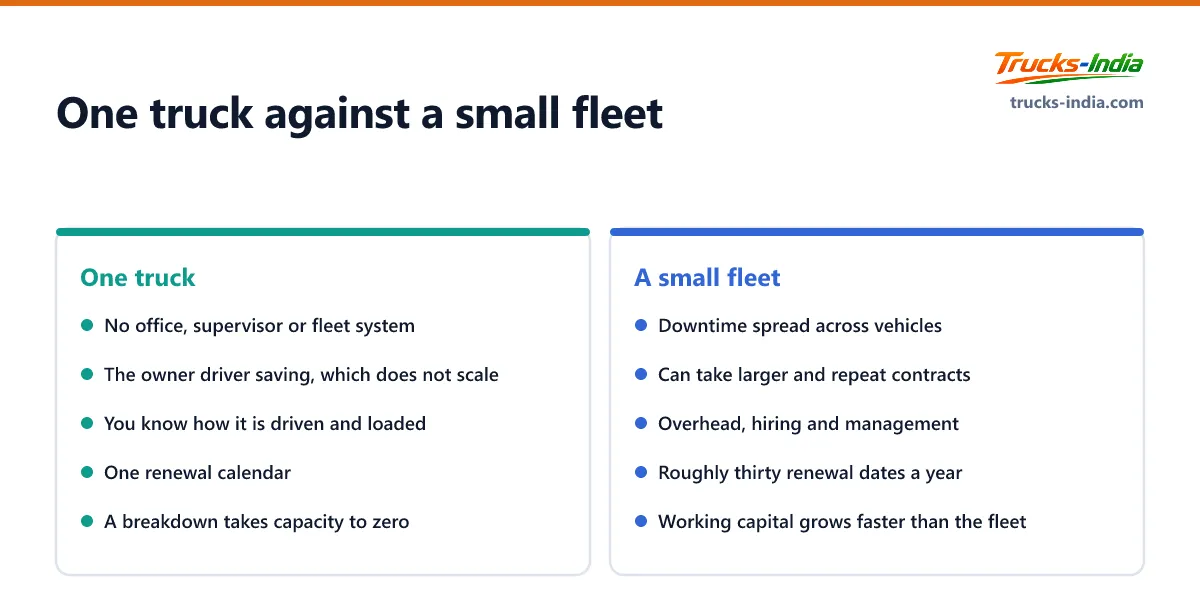
- Lower fixed overhead. No office, no supervisor, no fleet management system.
- The owner driver saving, which does not scale to a fleet.
- Tighter control. You know exactly how your vehicle is driven, loaded and maintained.
- Simpler compliance. One set of documents, one renewal calendar.
- No hiring problem, which is one of the most persistent difficulties in Indian road transport.
An owner driver running a well chosen truck on a corridor they know, with two or three steady clients and a filled return leg, can be more profitable per vehicle than a poorly run fleet of six.
When to add the second truck
The signals are reasonably clear.
- You are turning down work regularly rather than occasionally
- You have a reserve that survives both the payment cycle and a repair, and it is intact
- You have a driver you trust, or a route reliable enough to recruit for
- Your cost per kilometre is a number you know precisely rather than estimate
Adding a truck to solve a cash problem rather than a capacity problem is how single truck operators become two truck operators with two EMIs and the same shortage of loads.
For the income side of a single truck, see what actually reaches the owner each month. If you are thinking beyond one vehicle, scaling to a fleet covers what changes.
Trucks to compare
A few trucks for a transport business on Trucks India, with ex-showroom price and rated payload. Open one for its full price, specifications and mileage.
Browse more: Mini trucks, Light commercial vehicles, Heavy trucks, Mahindra trucks, Ashok Leyland trucks, Euler EV trucks, Premier Motors trucks
Frequently asked questions
Yes, particularly for an owner driver who removes the driver's salary from costs. It requires the vehicle to be matched to available loads, the return leg to be filled reasonably often, and a cash reserve deep enough to survive both the payment cycle and a breakdown.
They are different businesses. One truck has lower overhead and the owner driver advantage but carries total concentration risk. A fleet spreads risk and can grow, at the cost of overhead, hiring and management.
Downtime. A breakdown removes all capacity while every fixed cost continues. This is why preventive maintenance and a genuine cash reserve matter more at this scale than at any other.
Enough to cover two to three months of running costs, including the EMI, and ideally a major repair on top. The payment cycle and a breakdown frequently coincide.
When you are consistently turning down work, your reserve is intact, you know your cost per kilometre precisely, and you have a driver you trust. Not when cash is tight, because a second EMI does not fix a shortage of loads.
Where this fits
One truck is where most operators start. See our guide to starting a transport business for the full sequence.
With one truck, the choice of vehicle is the whole business. Trucks India lists mileage, payload and on road price for every model sold in India.
Call +91 93422 00875About the author
Lokesh R
CEO of Trucks India
Lokesh R is the founder of Trucks India, an independent heavy-vehicle marketplace and research platform operated from Chennai, Tamil Nadu, founded in 2025. Under his direction, Only Heavy publishes specifications and prices sourced from manufacturers, authorised dealer price lists and official regulatory schedules, with every model page checked by a named reviewer, prices re-verified monthly and after any GST revision, and no advertiser able to buy a rating, ranking or comparison result.


