
Transport Company Registration Process in India
How to register a transport company in India: choosing a structure, PAN and TAN, GST, Udyam and RTO commercial registration, in the order that actually works.

Lokesh R
CEO of Trucks India
Created 1 August 2026 · 7 min read

Registering a transport company is the least interesting part of starting one, and the part people most often get wrong. Not because it is difficult, but because they do it in the wrong order, or pick a structure that suits the business they have today rather than the one they will have in three years.
The registration itself is mostly forms and fees. What matters is the decision you make before the forms: which legal structure you are registering as, because that choice follows you into every loan application, every client contract and every tax return afterwards.
Here is the sequence, what each step actually involves, and where the ordering trips people up.
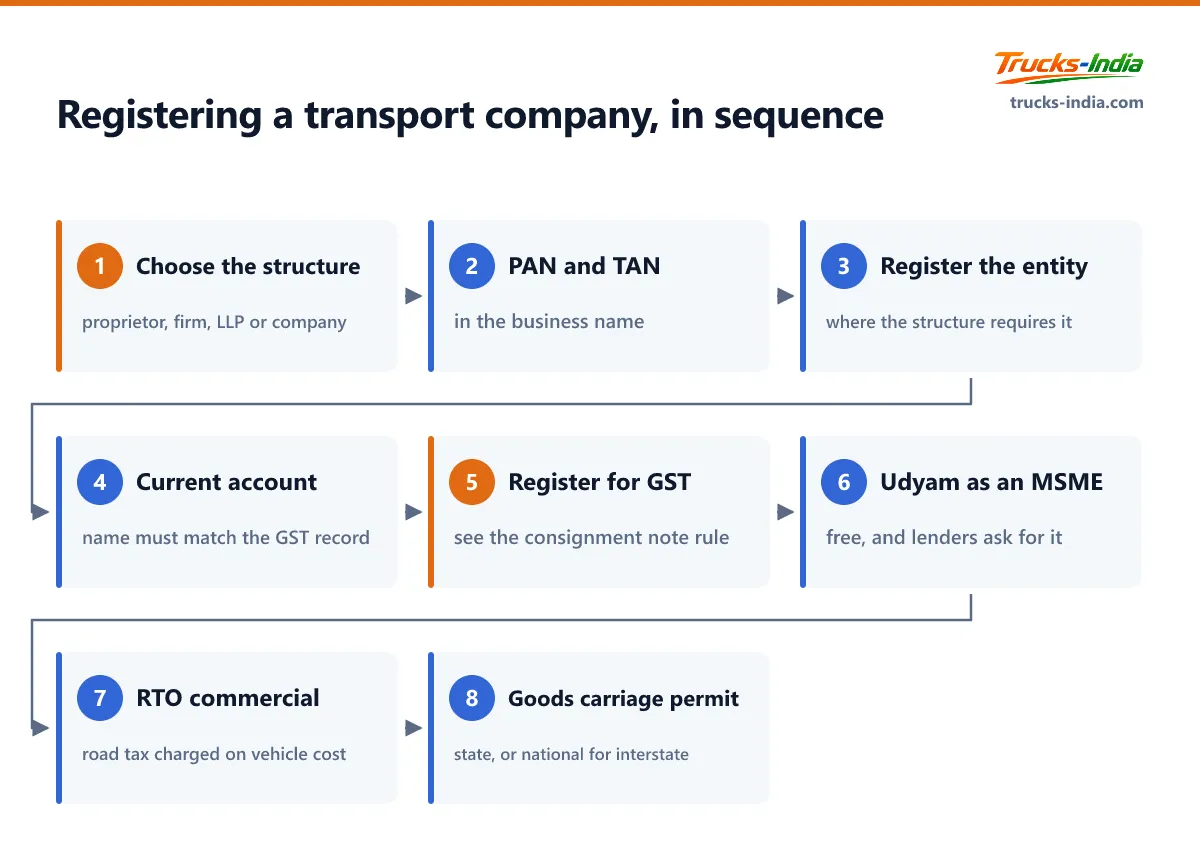
The transport company registration process, step by step
- Choose the legal structure
- Get a PAN and TAN in the business name
- Register the entity itself
- Open a current account
- Register for GST
- Register on Udyam as an MSME
- Register the vehicle commercially with the RTO
- Apply for the goods carriage permit
Steps one to six create the business. Steps seven and eight make it legal to carry goods for money. People routinely buy the truck first and then discover that the loan, the invoice and the permit all wanted an entity that did not exist yet.
Choose the structure before anything else
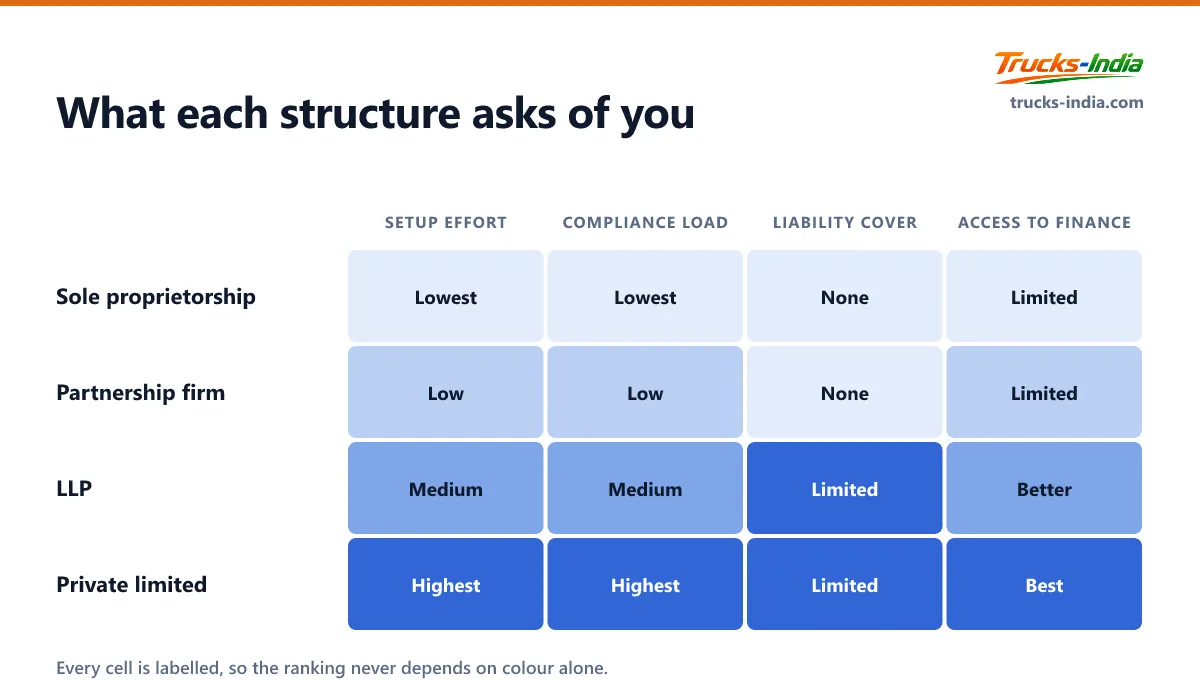
Four options are realistic for a goods transport business, and the honest way to choose is by how many vehicles you expect to run and who your clients will be.
Sole proprietorship. Fastest and cheapest. No separate registration for the entity itself, you simply register for GST and Udyam in your own name. Suitable for one or two trucks. The catch is unlimited liability: if the business owes money, your personal assets answer for it.
Partnership firm. A partnership deed, ideally registered with the Registrar of Firms. Common in family run fleets. Partners still carry unlimited liability, jointly and individually.
Limited liability partnership. Registered with the Ministry of Corporate Affairs. You get limited liability with lighter annual compliance than a company. A sensible middle for a fleet that is growing but not yet bidding for corporate contracts.
Private limited company. Heaviest compliance, and the easiest structure to raise institutional finance against. Large shippers running vendor onboarding often prefer or require it.
The practical rule: if you are buying one truck and driving it yourself, a proprietorship is not a compromise, it is the right answer. If you plan to hold contracts with manufacturers or e-commerce companies, start with an LLP or a company, because converting later means redoing your GST registration, your bank mandates and your client paperwork.
PAN, TAN and the bank account
A proprietorship uses your personal PAN. Every other structure gets its own PAN once the entity is registered. TAN is separate and you need it the moment you deduct tax at source, which in practice means as soon as you pay contractors or rent.
The current account comes next, and it is worth doing properly. Freight clients pay by transfer against an invoice in the business name, and a mismatch between the invoice name, the GST registration and the bank account is the single most common reason payments stall.
GST registration, and the rule that catches transporters
Most guides tell you the threshold is 20 lakh rupees of turnover, or 10 lakh in special category states. That is true for ordinary service providers and it does not protect you.
If you operate as a goods transport agency, meaning you issue consignment notes, the threshold is not the test to rely on. Most GTAs register. The exception worth knowing is Notification 5/2017, which exempts a person making only supplies taxed under reverse charge, so a GTA carrying exclusively for registered businesses can stay outside registration even above 20 lakh. Any output outside reverse charge ends that. Plan on registering and confirm your own position, because it turns on your customer mix rather than your size. Our GST guide sets out both rules.
On the rate, a goods transport agency chooses between 5 percent without input tax credit and 18 percent with it. The older 12 percent forward charge option was rationalised into 18 percent with effect from 22 September 2025, so any advice still offering 12 percent is out of date. The choice is exercised at the start of the financial year, which is a good reason to have this conversation with a chartered accountant before you begin rather than after.
Udyam, and why it is worth the ten minutes
Udyam registration is free, online and takes minutes. It records you as a micro, small or medium enterprise. It is what makes you eligible for several credit schemes, and lenders increasingly ask for the Udyam number on commercial vehicle loan applications. There is no reason to skip it.
RTO commercial registration and the permit
This is where the company stops being paperwork and becomes a transport business.
The vehicle is registered commercially with the Regional Transport Office and receives a commercial registration. Road tax is charged at that point and varies by state, calculated on vehicle cost, so budget for it separately from the truck's price.
Then the permit. A state goods carriage permit covers work inside your own state. Crossing a border for hire or reward requires a national permit, and the structure of that one surprises people: the permit document runs five years, but the authorisation that lets you operate across states is annual. The consolidated national permit authorisation fee is 16,500 rupees a year under Rule 87(2) of the Central Motor Vehicles Rules, paid through the Parivahan portal, with a Form 46 authorisation of about 1,000 rupees a year to your home state. Amounts vary by state and vehicle.
Alongside these you will carry a fitness certificate, commercial vehicle insurance, a pollution under control certificate and a commercial driving licence for whoever drives.
What this costs, roughly
Registration costs are small next to the vehicle, but they are not zero and they arrive early.
- Entity registration, from nothing for a proprietorship to a few thousand rupees for an LLP or company
- Professional fees for a chartered accountant or company secretary, if you use one
- RTO commercial registration and road tax, which varies by state and is charged on vehicle cost
- First year insurance
- Permit and fitness fees
- FASTag and an opening toll balance
The vehicle sits alongside all of this. If you are still choosing, our price bands make the comparison quick: trucks under 10 lakh for mini trucks and pickups, 10 to 20 lakh for the light and intermediate range, and 40 to 50 lakh where multi axle haulage begins.
The order people get wrong
Buying the truck before the entity exists is the classic. The loan is sanctioned to a person rather than a business, the invoice comes in the wrong name, and the GST input credit on the vehicle, if you were planning to claim it, is complicated or lost.
Register the entity, get the GST number, then buy. The extra fortnight at the start saves months of correction later.
Registration is one step in a longer sequence. The full guide to starting a transport business covers the other seven, and the document checklist sets out exactly what you need to assemble before you begin. Once the entity exists, sizing the investment is the next decision.
Frequently asked questions
No. A sole proprietorship is enough and is what most single truck owners use. You still need GST registration if you issue consignment notes or run interstate, plus commercial RTO registration and a permit for the vehicle itself.
A proprietorship with GST can be running in one to two weeks. An LLP or private limited company usually takes two to four weeks depending on name approval and document turnaround. RTO registration and the permit follow the vehicle purchase and add their own time.
Usually, but not automatically. The 20 lakh threshold is not the only test for a transporter. A goods transport agency whose entire output is taxed under reverse charge is exempt from registration under Notification 5/2017, even above the threshold, and loses that exemption as soon as any supply falls outside reverse charge. It turns on your customer mix rather than your turnover.
Yes, but it is not free. You redo the GST registration, the bank mandates, the vehicle ownership records and your client contracts. If you already know you are heading for corporate contracts, start with the structure you will need.
Udyam registers you as a micro, small or medium enterprise. It is free, takes minutes, and lenders often ask for the number on commercial vehicle loan applications. There is no good reason to skip it.
Where this fits
Registration is step three of eight. See the full sequence in our guide to starting a transport business.
Once the company exists, the next decision is the truck. Trucks India lists on road price, payload and mileage for every model sold in India.
Call +91 93422 00875About the author
Lokesh R
CEO of Trucks India
Lokesh R is the founder of Trucks India, an independent heavy-vehicle marketplace and research platform operated from Chennai, Tamil Nadu, founded in 2025. Under his direction, Only Heavy publishes specifications and prices sourced from manufacturers, authorised dealer price lists and official regulatory schedules, with every model page checked by a named reviewer, prices re-verified monthly and after any GST revision, and no advertiser able to buy a rating, ranking or comparison result.


