
Truck Engine Oil Capacity, Grade and Change Interval in India
Check truck engine oil capacity in litres, the right grade for BS6 engines, and the oil change interval manufacturers give, with what shortens it in Indian use.

Lokesh R
CEO of Trucks India
Created 29 September 2026 · 9 min read

Key takeaways
- Oil capacity scales with engine size: Cummins lists 16.7 litres total for its 6.7 litre B6.7 with the standard pan, and 19.7 litres with the high capacity pan.
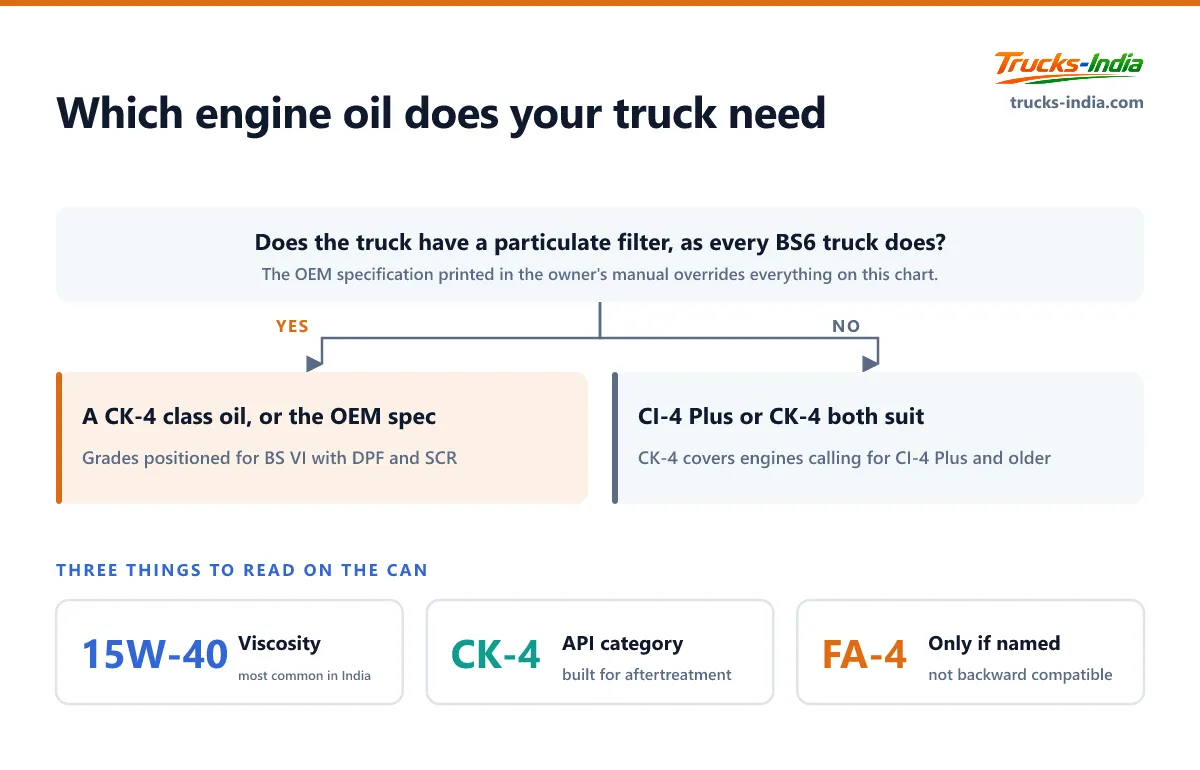
- A BS6 truck with a particulate filter needs an API CK-4 class oil or whatever the manual names; CI-4 Plus oils are positioned for engines without a DPF.
- Published drain intervals run from 60,000 km (BharatBenz heavy haulage, Tata Ultra T.16) to 1 lakh km (Tata Turbotronn 2.0), and severe duty cuts them sharply.
- Never extend a drain interval because the oil is synthetic or looks clean; Cummins says so in writing.
- The dipstick, not a litre figure from the internet, decides how much to add.
Engine oil is the cheapest insurance a truck owner buys. Get the quantity, the grade or the drain interval wrong, and the bill arrives later as a worn turbocharger, a choked particulate filter or a seized engine on a highway.
This guide covers truck engine oil capacity in litres by engine size, what grades like 15W-40 and CK-4 actually mean, how often manufacturers say to change the oil, and why a BS6 truck is fussier about all three than the older vehicle it replaced.
Truck engine oil capacity: how many litres an engine holds
There is no single number for truck engine oil capacity, because it follows two things: the size of the engine and the size of its oil pan. A mini truck and a 49 tonne tractor head can differ by a factor of ten.
Engine sizes across the Indian market show the spread. The Tata Ace Gold runs a 700 cc engine. An Eicher Pro 3015 sits at 3,800 cc. The Tata Signa 4825.TK uses a 6.7 litre Cummins engine of 6,692 cc, and the Volvo FM 420 4x2 carries a 12,800 cc unit.
The most useful published figures come from Cummins, whose 6.7 litre engines power many Indian heavy trucks. Its B6.7 truck maintenance quick reference guide lists:
- Standard oil pan: 14.2 litres in the pan, 16.7 litres for the total system
- High capacity oil pan: 17.2 litres in the pan, 19.7 litres for the total system
- Oil filter: about 0.95 litres
- Low to high mark on the dipstick: 1.9 litres
That last figure matters more than it looks. The gap between "low" and "full" on a heavy engine is close to two litres, so topping up a litre at a time is normal and pouring in a whole can blindly is how engines get overfilled.
Lorry engine oil capacity in litres, by segment
Use these as orders of magnitude, then read the exact figure for your lorry from the owner's manual or the service book.
- Mini trucks and pickups (engines of roughly 0.7 to 2.5 litres): single digit litres.
- Intermediate and medium trucks (3 to 5 litre engines): more than a pickup and less than a heavy truck, and the figure varies with the pan fitted.
- Heavy trucks with a 6.7 litre engine: roughly 16.7 to 19.7 litres for the total system, on the Cummins figures above.
- Tractor heads and tippers with 12 to 13 litre engines, such as Volvo and Scania: considerably more again, so treat the manual as the only reliable source.
Why the dipstick decides, not the litre figure
The total system capacity includes oil sitting in the filter, the cooler and the galleries. A routine drain never removes all of it, so a refill rarely takes the full published figure.
Fill to the dipstick, on level ground, with the engine off for a few minutes so the oil has drained back to the pan. Overfilling is not harmless: excess oil gets whipped by the crankshaft, foams, and protects worse than the correct level.
Heavy vehicle engine oil grade: what 15W-40 and CK-4 mean
Every engine oil label carries two separate pieces of information, and buyers often confuse them.
The viscosity grade, such as 15W-40, describes thickness. Its "15W" half covers cold starting, and the "40" covers thickness at operating temperature. For Indian conditions 15W-40 is the most common heavy vehicle engine oil grade, and Cummins recommends 10W-30 or 15W-40 for the B6.7, provided the oil meets its own CES 20086 or CES 20081 specification.
The service category, such as API CK-4, describes what the oil is chemically built to do. Most Indian lubricant makers print a category from the American Petroleum Institute's list of diesel oil categories on the can:
- CH-4 and CI-4: older categories built for pre-2010 engine designs; CI-4 was formulated for engines using exhaust gas recirculation.
- CJ-4: for engines built to 2010 on-highway standards.
- CK-4: the current heavy duty category, designed for engines with modern exhaust aftertreatment, and API says it can lubricate engines calling for CJ-4, CI-4 Plus, CI-4 and CH-4.
- FA-4: thinner xW-30 oils for select newer engines only. API states FA-4 oils are not interchangeable or backward compatible with CK-4 and the older categories.
BS6 engines and their oil
A BS6 truck has hardware an older truck never carried: a diesel particulate filter, an SCR catalyst and often EGR. The ash left by burnt oil collects in that filter, and some additive chemistry poisons the catalyst. That is why the oil category matters more now than it did on a BS3 vehicle. The BS6 emission norms guide explains how those systems work.
Lubricant makers position their products accordingly. Castrol's CRB Turbomax range page describes its CK-4 grade as compatible with diesel engines, including BS VI, fitted with EGR, DPF, DOC or SCR. The same page positions the CI-4 Plus grade for BS II, BS III and BS IV vehicles without a DPF. Mobil's Delvac Modern 15W-40 Advanced Fleet is likewise listed for BS VI and BS IV engines using DPF and SCR.
The practical rule is short. Pick the specification your truck manufacturer names in the manual first, and the API category second. A cheaper CI-4 Plus oil in a BS6 truck saves a few hundred rupees per change and risks a particulate filter that costs far more.
Truck engine oil change interval
Ask five owners how often to change truck engine oil and you will hear five numbers, because the interval genuinely varies by manufacturer, engine generation and duty cycle. Here is what manufacturers themselves publish.
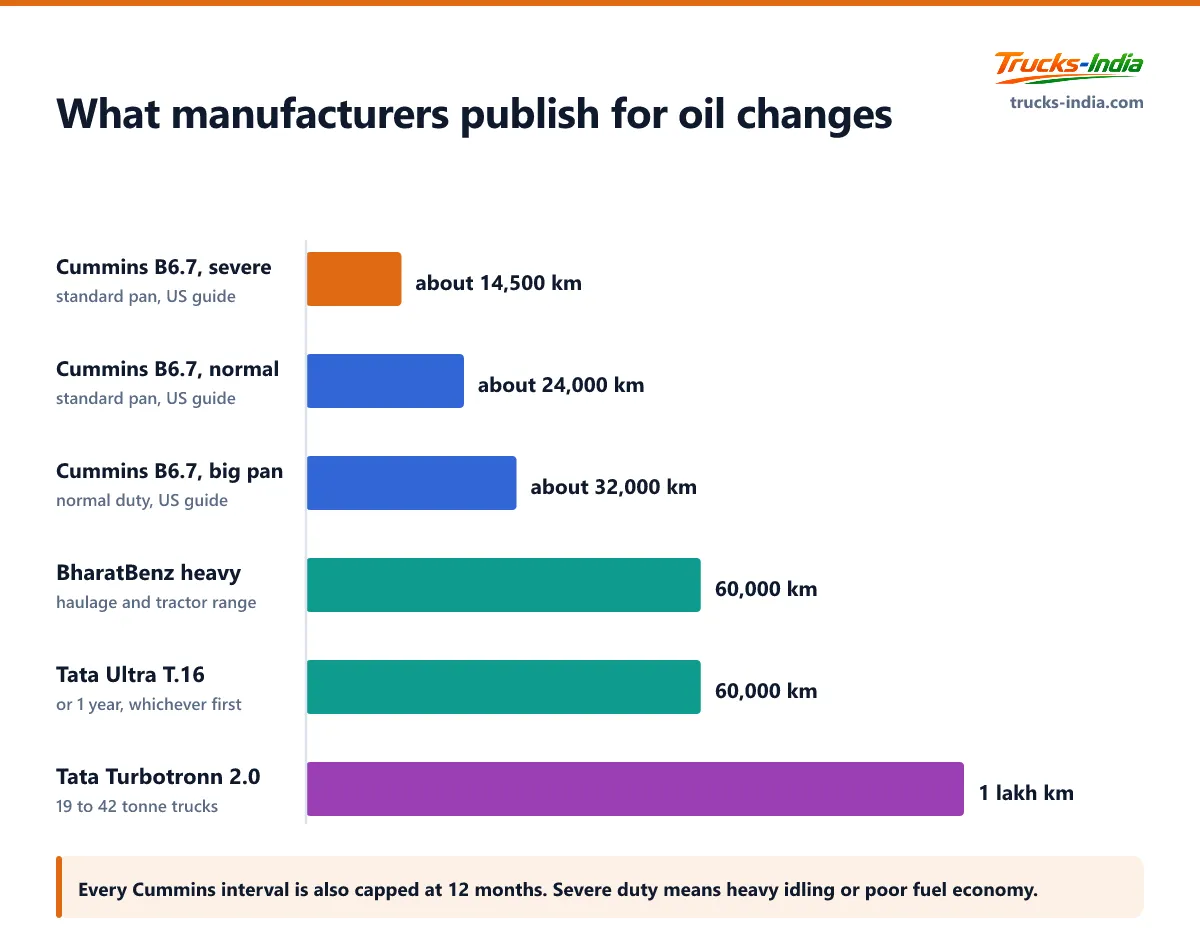
- BharatBenz says on its BS VI trucks page that it raised service intervals on its heavy haulage and tractor range from 50,000 km to 60,000 km.
- Tata Motors lists a service interval of 1 year or 60,000 km on its Tata Ultra T.16 specification page.
- Tata's Turbotronn 2.0 engine for 19 to 42 tonne trucks was launched with oil drain and service intervals of 1 lakh km, according to the Tata Motors press release.
- Cummins, in the US version of its B6.7 guide, splits the interval by duty. With the standard pan it is 9,000 miles (about 14,500 km) in severe duty and 15,000 miles (about 24,000 km) in normal duty. On the larger pan it is 12,000 miles (about 19,300 km) and 20,000 miles (about 32,000 km), and every one of those intervals is capped at 12 months.
The Cummins numbers show the two levers clearly. A bigger sump holds more additive, so it lasts longer. Harder work uses that additive faster, so severe duty cuts the interval by around 40 percent.
Older trucks and small commercial vehicles generally sit well below the newest heavy engine intervals. For the general shape of a service calendar, the truck maintenance cost and schedule guide owns the full schedule, and your own manual overrides any published range.
What counts as severe duty in India
Cummins defines severe duty as fuel economy under 7 miles per gallon (roughly 3 km per litre) or more than 40 percent idling. Indian work hits those conditions often:
- City distribution with constant stop and start
- Long idling, at loading points, toll queues and border checks
- Tipper, mining and construction work with dust and heavy loads at low speed
- Ghat routes that keep the engine near full load for hours
- Running overloaded, which also strains the gearbox, clutch and brakes
If most of your kilometres look like that list, plan for the shorter end of whatever interval your manual gives.
Synthetic oil does not buy a longer interval
Cummins is blunt on this point: synthetic or semi synthetic oils may help in extreme heat or cold, but do not extend the oil drain interval because of them. The same applies to oil that still looks clean. Diesel oil darkens almost immediately because it is holding soot in suspension, so colour tells you very little.
Checking and topping up between changes
A daily oil check is part of the driver's ten minute walk round, before the first trip. On an older lorry that burns some oil, it is the check that saves the engine.
- Park on level ground and check before starting, or a few minutes after stopping.
- Pull, wipe and re-insert the dipstick, then read it.
- Top up only with the same specification that is in the engine.
- Write it down. A truck that needs a litre every few hundred kilometres is telling you something about rings, valve seals or the turbocharger.
Watch for three warning signs between changes. A rising oil level can mean fuel or coolant is getting into the sump. Milky oil points to coolant contamination. A low oil pressure warning means stop the engine, not drive on to the next town.
Keeping engine oil in good shape also protects fuel economy, since a worn engine burns more diesel for the same load. The guide to increasing truck mileage covers the driving side of that.
Getting it right on your truck
Three numbers belong in every truck's service file: the oil specification, the refill quantity with filter, and the drain interval for the way that truck actually works. Get all three from the manual or the authorised dealer once, write them inside the cab document folder, and check every workshop invoice against them.
Truck engine oil capacity, grade and interval are not trivia. On a BS6 truck, they decide whether the engine and its aftertreatment reach the end of the warranty without an expensive argument.
Trucks to compare
A few popular trucks on Trucks India, with ex-showroom price and rated payload. Open one for its full price, specifications and mileage.
Browse more: Mini trucks, Light commercial vehicles, Heavy trucks, Ashok Leyland trucks, Mahindra trucks
Frequently asked questions
It depends on engine size and the oil pan. Mini trucks and pickups take single digit litres. A 6.7 litre heavy truck engine takes roughly 16.7 to 19.7 litres for the total system on Cummins' published figures, and 12 to 13 litre engines take considerably more. Your owner's manual gives the exact refill quantity.
15W-40 is the most common viscosity grade in Indian conditions. The service category matters just as much: BS6 trucks with a particulate filter need an API CK-4 class oil, or the specific OEM specification printed in the manual.
It varies by manufacturer and duty. BharatBenz quotes 60,000 km on its heavy haulage range, Tata quotes 1 year or 60,000 km on the Ultra T.16, and Tata's Turbotronn 2.0 engine claims 1 lakh km. Severe duty such as city work, idling and tipper use shortens every one of these.
Lubricant makers position CI-4 Plus oils for BS II to BS IV engines without a particulate filter. A BS6 truck has a DPF and SCR system, so use the CK-4 class oil or the OEM specification the manual names.
CK-4 is the newer API category, built for engines with modern exhaust aftertreatment. API says CK-4 oils can also lubricate engines that call for CI-4, CI-4 Plus, CJ-4 and CH-4. The reverse is not true for BS6 engines.
No. Diesel engine oil turns dark almost immediately because it holds soot in suspension, which is part of its job. Change it by the kilometres and months your manual gives, not by its colour.
Where this fits
Oil changes are one line in the service calendar. See our guide to truck maintenance cost and schedule for the full plan.
Engine size decides oil volume, and oil volume decides running cost. Trucks India lists every model sold in India with engine, payload, mileage and price.
Call +91 93422 00875About the author
Lokesh R
CEO of Trucks India
Lokesh R is the founder of Trucks India, an independent heavy-vehicle marketplace and research platform operated from Chennai, Tamil Nadu, founded in 2025. Under his direction, Only Heavy publishes specifications and prices sourced from manufacturers, authorised dealer price lists and official regulatory schedules, with every model page checked by a named reviewer, prices re-verified monthly and after any GST revision, and no advertiser able to buy a rating, ranking or comparison result.


