
Truck Air Brake System: How It Works, Pressure and Daily Checks
Learn how a truck air brake system works, what air brake pressure is normal, why spring brakes make it fail safe, and the daily checks every driver should run.

Lokesh R
CEO of Trucks India
Created 29 September 2026 · 8 min read

Key takeaways
- In a truck air brake system, air holds the parking springs off; lose the air and the spring brakes apply on their own.
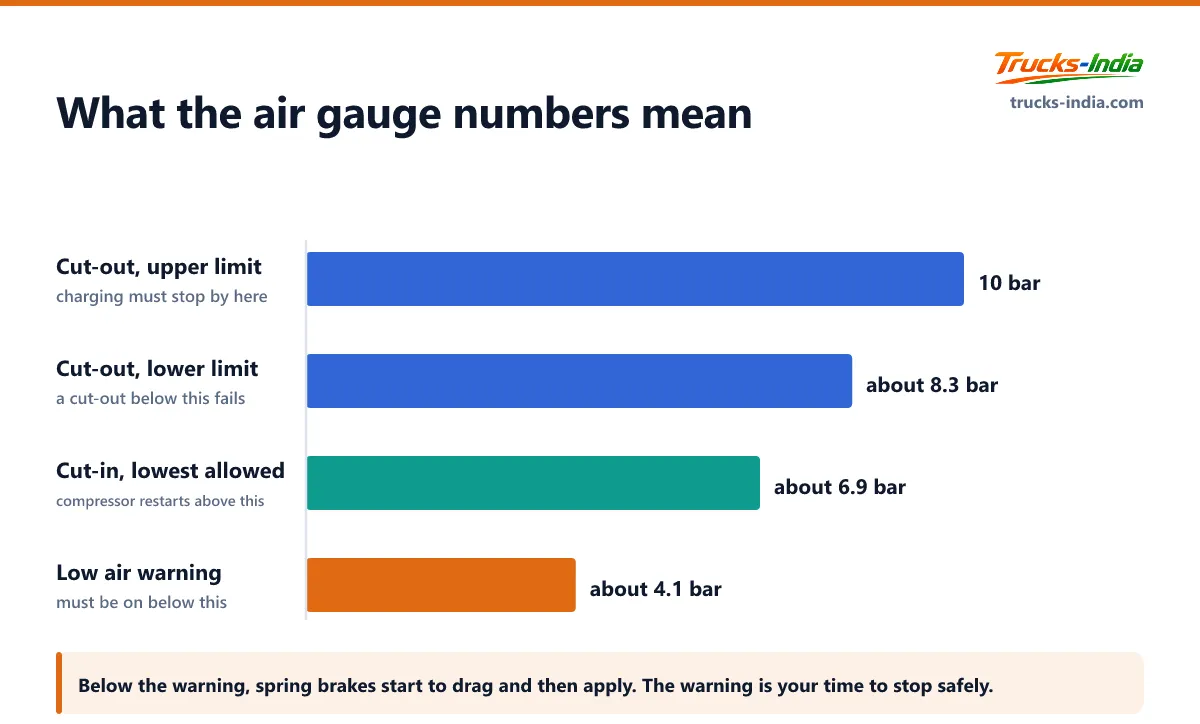
- As a published reference, British Columbia's inspection standard expects governor cut-out between 8.3 and 10 bar and a low air warning by the time pressure falls below 4.1 bar; your manual gives your truck's figures.
- The revised braking standard IS 11852:2019 becomes mandatory for trucks from 1 October 2027, according to a Ministry of Road Transport and Highways release.
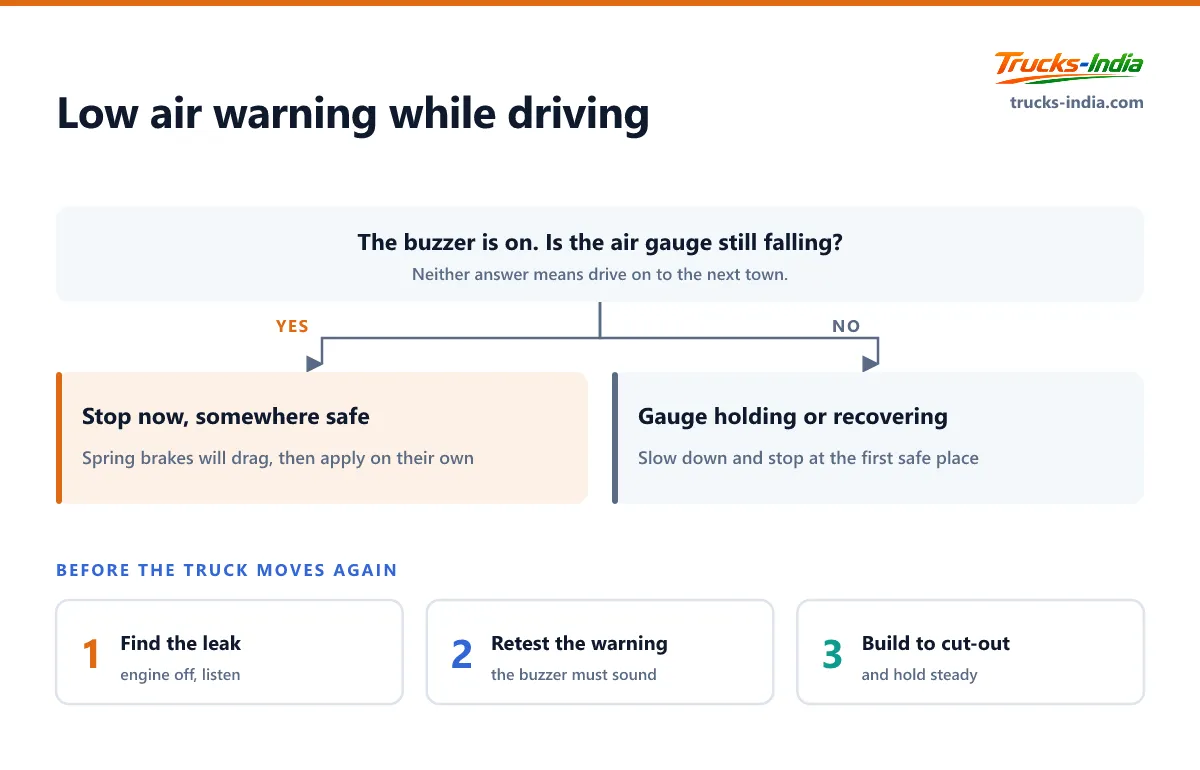
- If the low air warning comes on while driving and the gauge keeps falling, stop safely at once rather than try to reach the next town.
- Draining moisture, testing the warning buzzer and checking for leaks with the engine off take a few minutes and catch most air brake faults.
A loaded heavy truck needs an enormous amount of force to stop, and it needs that force every time, on a ghat descent, in city traffic and at the end of a twelve hour shift. The truck air brake system delivers it, and it is also designed to stop the truck by itself if the air runs out.
This guide explains how a truck air brake system works, part by part, what the pressure gauge should show, why spring brakes make the system fail safe, what Indian rules require, and the daily checks that catch trouble before it reaches the road.
How a truck air brake system works
A truck air brake system uses compressed air, rather than brake fluid, to push the brake shoes against the drums. Air is made on board, stored in tanks, and released into the brakes when the driver presses the pedal.
The parts, in the order the air travels through them:
- Compressor. Driven by the engine, it pumps air whenever the engine runs.
- Governor. It tells the compressor when to stop charging (cut-out) and when to start again (cut-in), so pressure stays within a set band.
- Air dryer. It removes moisture and oil from the air before storage, and purges with a short hiss.
- Reservoirs. Steel or aluminium tanks hold the compressed air. Most trucks split them into separate circuits so a failure in one does not take out the other.
- Foot brake valve. The pedal meters how much air goes to the brakes; push harder and more air flows.
- Relay valves. These sit near the axles and speed up application on long vehicles.
- Brake chambers. Air pushes a diaphragm and a push rod out of each chamber.
- Slack adjusters and S-cam. The push rod turns the slack adjuster, which rotates an S-shaped cam that spreads the shoes against the drum.
Manufacturers describe their layouts in these terms. Eicher's Pro 3012 specification page lists a full air brake with divided line and auto slack adjusters at all wheel ends, and its Pro 6048XP page lists dual circuit full air, S-cam, with ABS on the 47,500 kg Eicher Pro 6048XP.
Spring brakes: why losing air stops the truck
The rear brake chambers on a heavy vehicle usually carry a second section with a very strong spring inside. That spring applies the brake. Air pressure is what holds it back.
When the driver pulls the parking brake, the hand valve releases the air from those chambers and the springs clamp the brakes on. If pressure in the system falls too low, the same thing happens without anybody touching a lever. The brakes start to drag as pressure drops, and then apply fully.
That is the heart of the design. A hydraulic system that loses its fluid loses its brakes. An air system that loses its air ends up braked.
The flip side matters on a breakdown. A truck with no air cannot be towed until the spring brakes are mechanically caged, or wound off, using the release bolt on each chamber. Chock the wheels before anybody does that, because the moment the springs are caged the truck has no parking brake at all.
Why do trucks need air brakes
Light trucks and pickups manage with hydraulic brakes. Loaded lorries are a different problem. A heavy vehicle air brake system exists because heavy vehicles have problems hydraulics handle badly.
- Force. A loaded heavy truck carries tens of tonnes. Air at several bar acting on a large diaphragm produces the clamping force those brakes need without a huge pedal effort.
- An unlimited supply. The compressor keeps making air for as long as the engine runs. A small leak is made up continuously; a small hydraulic leak simply empties the system.
- Fail safe behaviour. Spring brakes apply when air is lost, so the failure mode is a stopped truck.
- Trailers. Air lines couple and uncouple quickly between a tractor and a trailer, and the trailer's own reservoirs and spring brakes work the same way.
Overloading cancels a large part of these advantages. Brakes are sized for the rated load, and every extra tonne lengthens the stopping distance and heats the drums faster, which the axle load guide covers from the legal side.
Truck air brake pressure: what the gauge should show
Indian truck manufacturers specify governor settings and warning pressures in each model's owner's manual, and those figures override anything general. As a published reference point, the vehicle inspection manual used in British Columbia, Canada, sets out what inspectors accept on a heavy vehicle.
On that standard, a truck fails inspection if the governor cut-in is below 690 kPa (about 6.9 bar), if the cut-out is below 828 kPa (about 8.3 bar) or above 1,000 kPa (10 bar), or if the low air warning does not come on when pressure falls below 414 kPa (about 4.1 bar). The same manual rejects a system where a single full brake application drops pressure by more than 138 kPa, about 1.4 bar.
Read your own gauge against those bands. Once the engine has run for a few minutes, the needle should climb steadily, stop at cut-out with the dryer's purge hiss, and then sit still with the brakes released.
What a falling gauge means
Pressure that will not build, or keeps dropping with the engine running, points to a leak, a tired compressor, a sticking governor or a blocked dryer. A steady drop with the engine off and the brakes released is a leak you can usually hear. Neither is a fault to drive on.
Heavy vehicle air brake rules in India
The Central Motor Vehicles Rules require two independent braking systems on motor vehicles: the service brake operated by foot and a parking brake. On an air braked truck these are the foot valve circuits and the spring brakes.
Brakes are part of every fitness test. A truck with leaks, a weak warning system or uneven braking will not pass, which the fitness certificate guide covers with the renewal schedule.
The standard is getting stricter. A Ministry of Road Transport and Highways release states that the revised braking standard IS 11852:2019 has been mandated for trucks from 1 October 2027, under GSR 834(E) dated 11 November 2025. Earlier, that standard applied only to buses built by manufacturers. The same release covers electronic stability control and advanced emergency braking for heavy vehicles, so new trucks from 2027 will carry more braking electronics than today's.
Daily air brake checks
These take a few minutes before the first trip and catch most faults while the lorry is still parked. Make them part of the driver's routine, not something done only before a fitness test.
- Drain the reservoirs, or confirm the automatic drains and the dryer purge are working. Water in the tanks corrodes valves and carries oil sludge into the system.
- Watch the build up. Start the engine and check the needle climbs steadily to cut-out and the governor stops charging.
- Test the warning. With the engine off, pump the brake pedal to bleed pressure down until the buzzer and light come on. A warning that never sounds is a defect.
- Listen for leaks. With the engine off and brakes released, the gauge should hold. Then hold a full application and check again.
- Check the parking brake holds the truck in gear on a slope.
- Walk round. Look for chafed hoses, loose chambers, broken push rods and a slack adjuster that travels further than its neighbours.
A truck that fails any of these stays parked until it is fixed. The truck maintenance cost and schedule guide puts the air dryer cartridge and a full brake inspection on the annual list.
Lorry air brake problems on Indian routes
- Brake fade on ghats. Long descents heat the drums until friction falls away. Use a lower gear and the exhaust brake, and brake firmly in short bursts rather than riding the pedal.
- Oil in the air. A worn compressor pumps oil into the system, which ruins dryer cartridges and valve seals.
- Uneven braking. One wheel pulling usually means an adjuster, a weak chamber or contaminated linings on that wheel.
- Slow build up. Often a slipping compressor drive, a leak or a sticking governor rather than the compressor itself.
A truck air brake system is reliable precisely because it is simple, but it is only as safe as the daily check that goes with it. Five minutes at the start of the shift is the cheapest safety equipment on the vehicle.
Trucks to compare
A few popular trucks on Trucks India, with ex-showroom price and rated payload. Open one for its full price, specifications and mileage.
Browse more: Mini trucks, Light commercial vehicles, Heavy trucks, Mahindra trucks, Tata Motors trucks, EKA trucks
Frequently asked questions
Heavy trucks need far more braking force than a hydraulic system can deliver comfortably. Air brakes also have an unlimited supply from the engine driven compressor, tolerate small leaks, couple easily to trailers and fail safe, because spring brakes apply when air is lost.
Each manufacturer specifies its own range in the owner's manual. As a reference, British Columbia's inspection standard expects governor cut-out between about 8.3 and 10 bar, cut-in no lower than about 6.9 bar, and a low air warning by about 4.1 bar.
The low air warning buzzer and light come on first. If pressure keeps falling, the spring brakes begin to drag and then apply fully. Stop safely as soon as the warning appears rather than trying to reach the next town.
A strong spring inside the rear brake chamber applies the brake, and air pressure holds it off. Pulling the parking brake releases that air so the spring clamps on; low system pressure does the same thing automatically.
The hiss is air being released. When the driver lifts off the brake pedal, air vents from the brake chambers, and when the governor reaches cut-out the air dryer purges moisture with a short burst.
Hydraulic brakes use sealed fluid pushed by the pedal, which suits cars, pickups and light trucks. Air brakes use compressed air made on board, deliver much more force for heavy vehicles, and apply spring brakes if the supply fails.
Where this fits
Brakes are inspected at every fitness test. See our guide to the fitness certificate for commercial vehicles.
Brake specification differs by model, from divided line systems on medium trucks to ABS on heavy haulers. Trucks India lists every model sold in India with payload, mileage and price.
Call +91 93422 00875About the author
Lokesh R
CEO of Trucks India
Lokesh R is the founder of Trucks India, an independent heavy-vehicle marketplace and research platform operated from Chennai, Tamil Nadu, founded in 2025. Under his direction, Only Heavy publishes specifications and prices sourced from manufacturers, authorised dealer price lists and official regulatory schedules, with every model page checked by a named reviewer, prices re-verified monthly and after any GST revision, and no advertiser able to buy a rating, ranking or comparison result.


